GPT-6 Astra vs GPT-5.6 Sol: compare total task cost
Compare GPT-6 Astra and GPT-5.6 Sol using provider-specific prices, cache charges and accepted results. Check routing before deciding whether to switch.
 Ofox
Ofox 
Choose between GPT-6 Astra and GPT-5.6 Sol by comparing the cost of an accepted result on the same task. The input price alone misses output, cache writes, cache reads, failed attempts and manual repair. First decide which provider and route you are comparing: OpenAI’s direct price and an Ofox provider quote are not interchangeable.
This update checks published specifications and current catalog prices on September 16, 2026. It does not report a new coding benchmark or claim a universal winner.
Compare the correct rate cards
Rates below are US dollars per million text tokens, before any separate applicable charges. OpenAI figures come from its model directory and caching guide. Ofox figures come from its current catalog, with list and provider fields kept separate.
| Service and model | Ordinary input | Output | Cache read | Cache write |
|---|---|---|---|---|
| OpenAI direct: GPT-6 Astra | $10 | $50 | $1 | $12.50 |
| OpenAI direct: GPT-5.6 Sol | $4 | $20 | $0.40 | $5 |
| Ofox list: GPT-6 Astra | $10 | $50 | $1 | $12.50 |
| Ofox list: GPT-5.6 Sol | $5 | $30 | $0.50 | $6.25 |
| Ofox Azure Foundry provider quote: GPT-5.6 Sol | $2.50 | $15 | $0.25 | $3.125 |
The Ofox catalog’s Azure Foundry quote for Astra matches its list values. The lower Sol provider quote is a separate catalog field; it is not a claim about buying directly from Azure or a guarantee that every Ofox request uses that rate. Confirm the route shown for your request and the resulting charge.
Catalog provenance for this review follows the GitHub catalog handler and its backing current response, retained with the editorial verification record. Price fields were normalized from per-token values to per-million values. A missing price field was not treated as zero. These are catalog quotes, not new paid-test receipts.
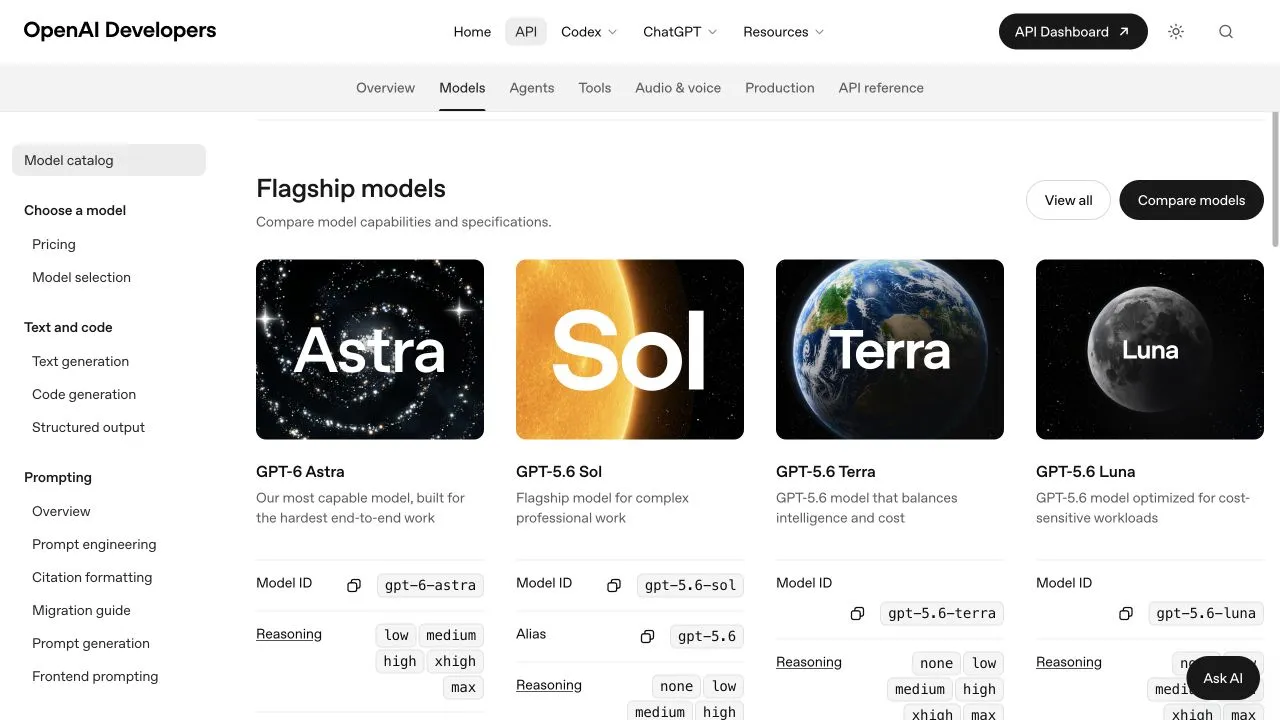
OpenAI model directory, captured September 16, 2026. This screenshot identifies the official models; it does not show Ofox’s route-specific rate card.
Include the first cache write
The current OpenAI guide prices GPT-5.6-and-later cache writes at 1.25 times ordinary input, and reads at 0.1 times ordinary input. The write rate replaces the ordinary rate for those tokens. It is not a second charge to add on top of the ordinary price.
If your first request writes a prefix and later requests reuse it, calculate both stages. If they do not reuse it, a low cache-read rate provides no saving. Use the cache-cost worksheet to separate the categories without counting tokens twice.
The Astra pricing guide covers additional pricing context. Keep its date and provider scope attached to any example you reuse.
Compare one completed job, not one attractive answer
Start both candidates from the same repository snapshot. Give them the same task, allowed tools, reference material and acceptance check. Record each model’s actual settings; a similarly named effort setting is not a promise of equal compute.
| Record | What to compare |
|---|---|
| Acceptance result | Did the requested behavior pass the agreed check? |
| Time | Include failed attempts and required repair, not only generation |
| Cost | Include ordinary input, cache, output and other billed work |
| Manual intervention | Count corrections needed before acceptance |
| Failure details | Keep incomplete output and unsuccessful tool calls in the record |
A task that passes on Sol with little repair may not need migration. A task that repeatedly fails on Sol can justify a bounded Astra trial. Those are decision rules, not measured claims that one model will win your workload.
If the agent spends the run repeating checks without progress, first use the Codex task-completion guide. A vague task or broken environment can dominate a model comparison.
Check model IDs instead of inventing the next name
On September 16, the inspected official directory listed gpt-6-astra and gpt-5.6-sol. It did not provide a formal GPT-6 Sol entry. That observation cannot establish that no future Sol, Terra or Luna release will occur.
Do not generate a guessed API identifier by replacing a version number in an old configuration. Resolve the available model from the selected provider’s documentation or model list, then test the required request and tool flow. The coding-agent setup guide covers migration checks; availability can differ by client, account and route.
Frequently Asked Questions
- Is Astra exactly twice as expensive?
- Not as a universal statement. The Ofox list input ratio is two, while the direct OpenAI input ratio in this snapshot is 2.5. Output, route overrides, caching and retries change the complete bill.
- Does a larger context window settle the comparison?
- No. The official directory lists a 1.05M context window and 128K maximum output for both models. Those limits do not establish accuracy or task completion on a long conversation.
- Should I remove Sol as soon as Astra passes a test?
- Keep a known-working route available while you evaluate representative tasks. A successful example is evidence for that example, not a complete production migration review.